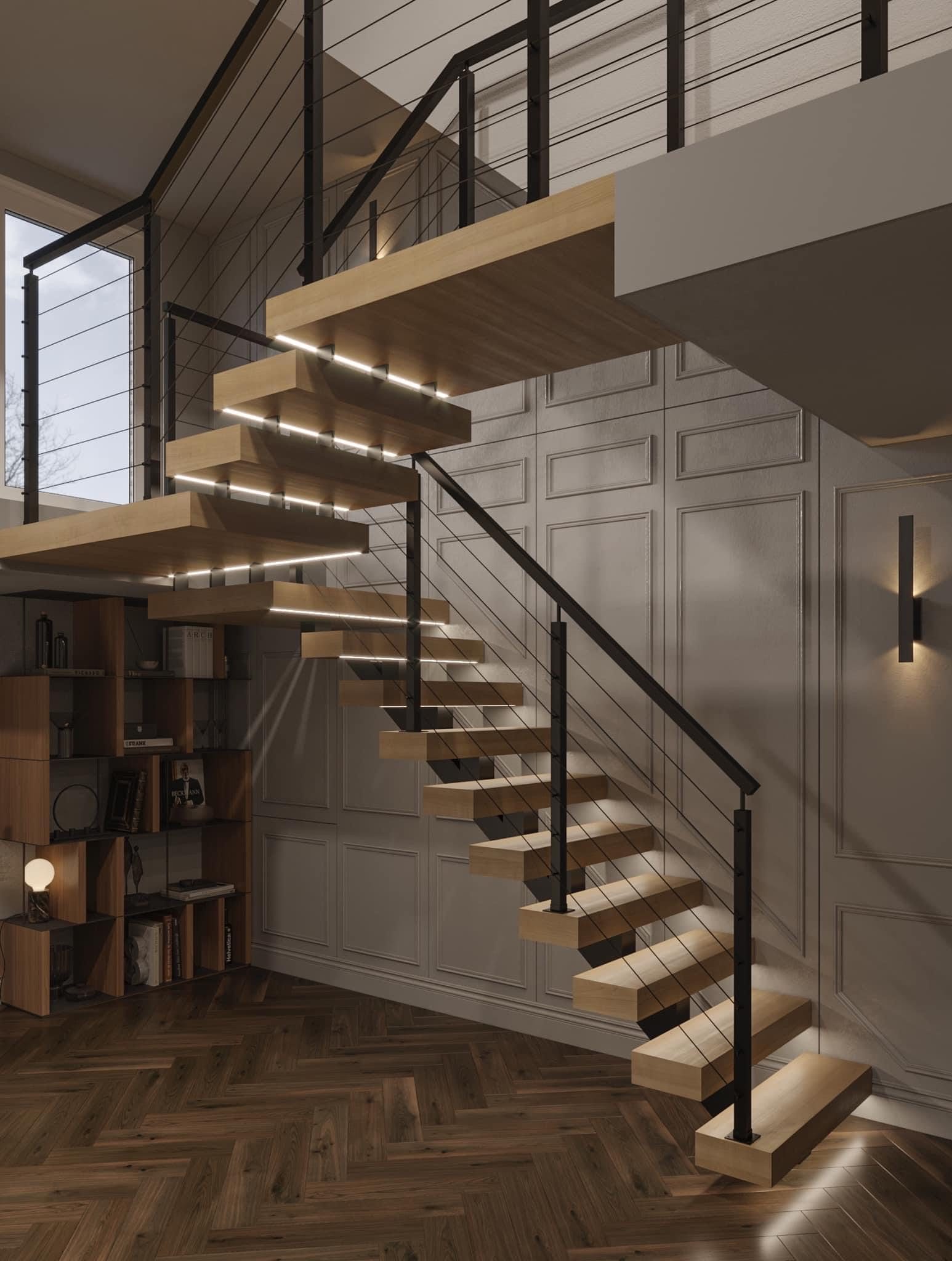
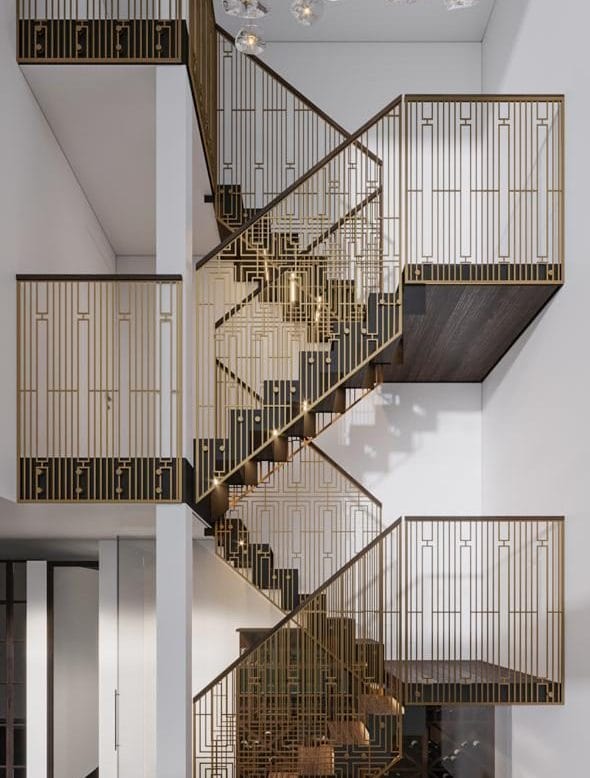
Most staircase companies work from a set menu of standard solutions. We’ve always done the opposite! The projects we’re proudest of are the ones nobody else wanted to take on, and The Cantilever is one of them. You’ll find plenty of finished showpieces in the V.PSTAIRS portfolio, but this one is different. It’s an engineering story first and a beauty story second, and it’s worth telling honestly. Let us walk you through how we built a metal frame that stands on its own.
How did it start? The client had already engaged another contractor to build the structural metal frame for a floating staircase. The result couldn’t do the one thing it absolutely had to do: hold a static, vibration-free position under the load of full stone-clad treads and a 17.5 mm laminated glass balustrade. So the client came to us to start again and get it right.
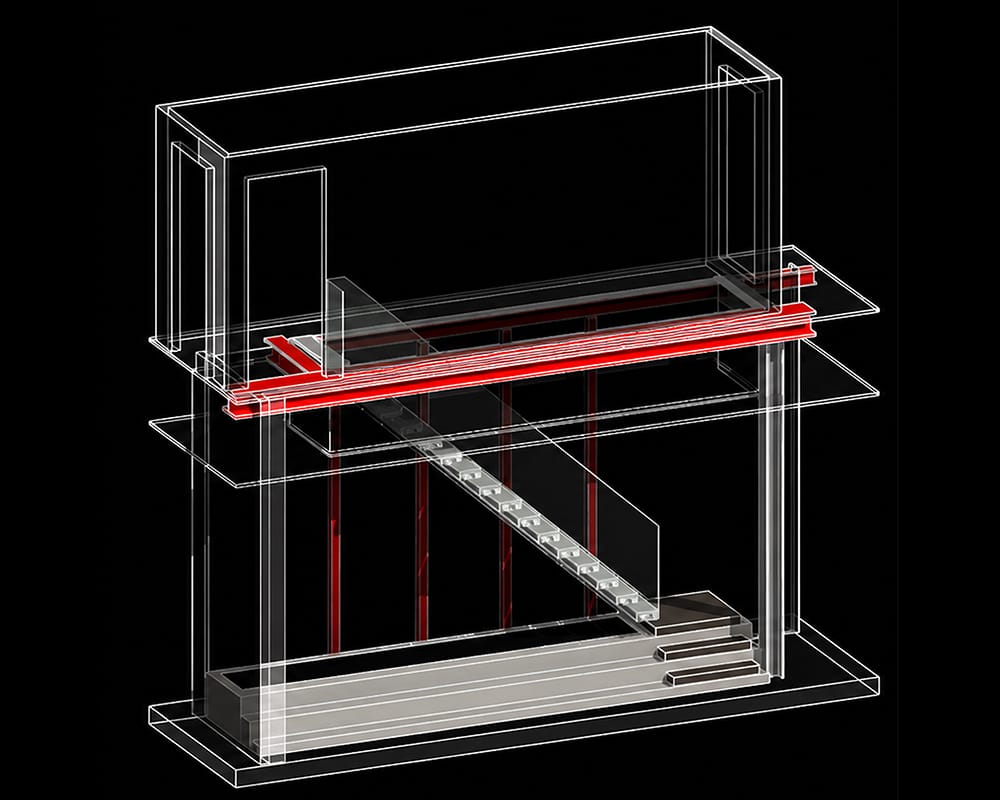
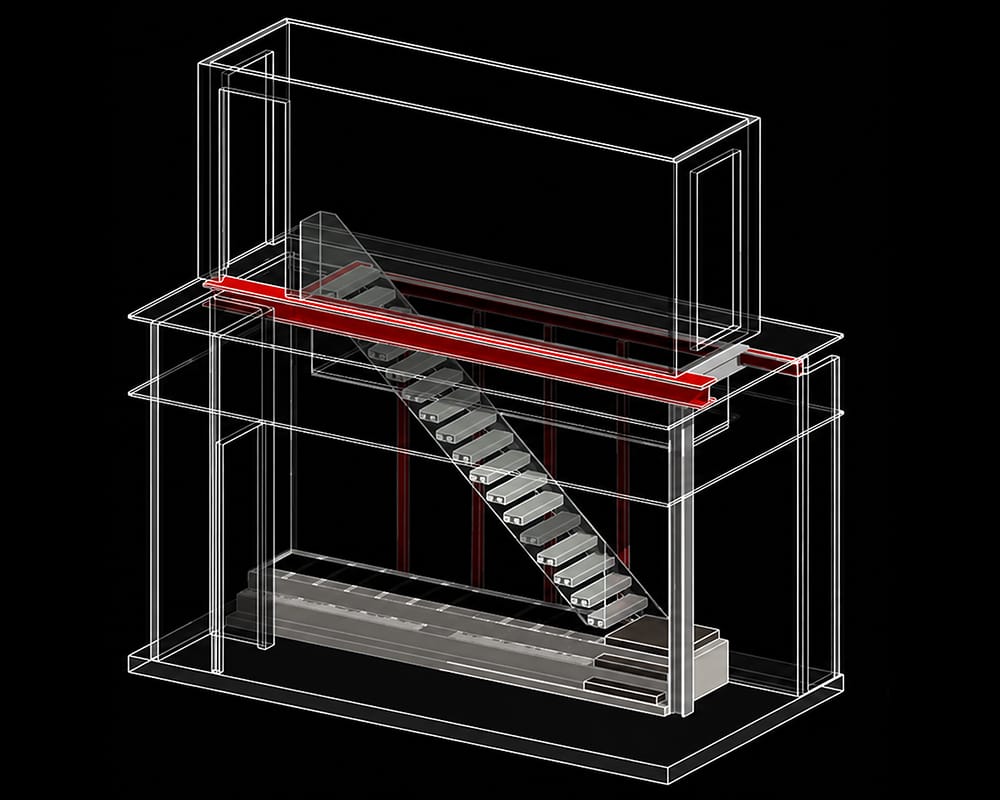
The complication that defeated the first attempt was the same one we had to solve. This is a basement-level staircase, and the supporting wall is finished with a specialist waterproofing membrane that protects the room from ground moisture. The client’s brief was unambiguous: under no circumstances could anything be fixed into that wall. That single constraint rules out the easiest path in floating-staircase work, which is to anchor the stringer to the structure behind it. We had to make the staircase carry itself.
“THE CANTILEVER: A METAL FRAME THAT STANDS ON ITS OWN”
close projects
happy clients
square arears
world awards
A Stringer With Nowhere to Anchor
On most floating staircases, the load-bearing stringer ties back into a load-bearing wall. Here it couldn’t. The membrane behind the staircase was off-limits, so our structural steel stringers transfer their load instead into a set of support beams, and those beams are likewise independent of the protected wall. We worked strictly from a measured model and ran a full structural calculation, exactly as our design standards require. A few principles guided the build:
The protected membrane wall stays untouched, with all load routed through independent beams.
Steel grade and section thickness are sized from the calculated loads, not assumed.
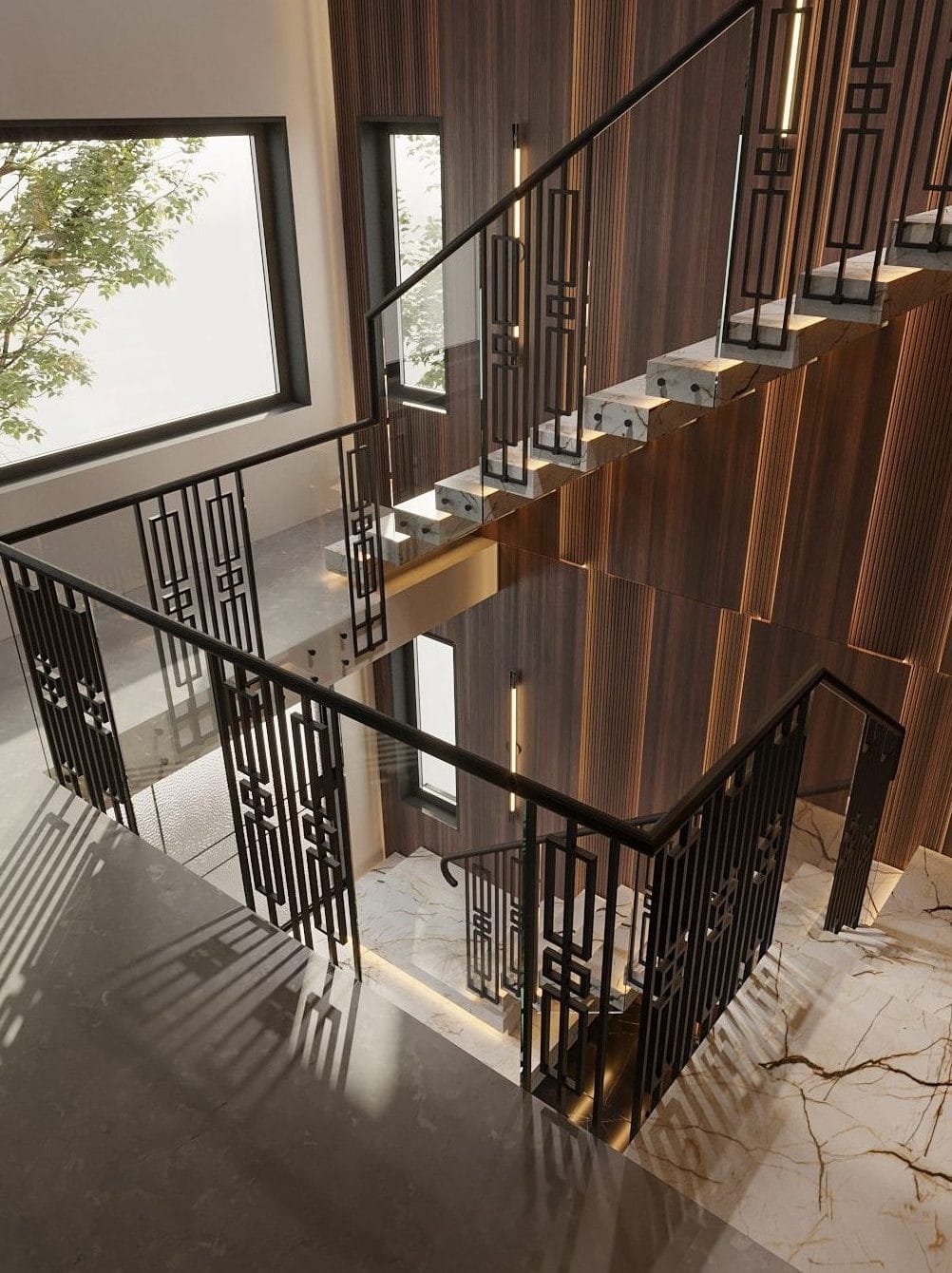
The frame is engineered to receive the heavy stone cladding and glass balustrade to follow.
The most important thing was to ensure that the metal framework was properly prepared so that it could support the weight of the natural stone cladding + the weight of people.
Unique Tab and Slot Joint
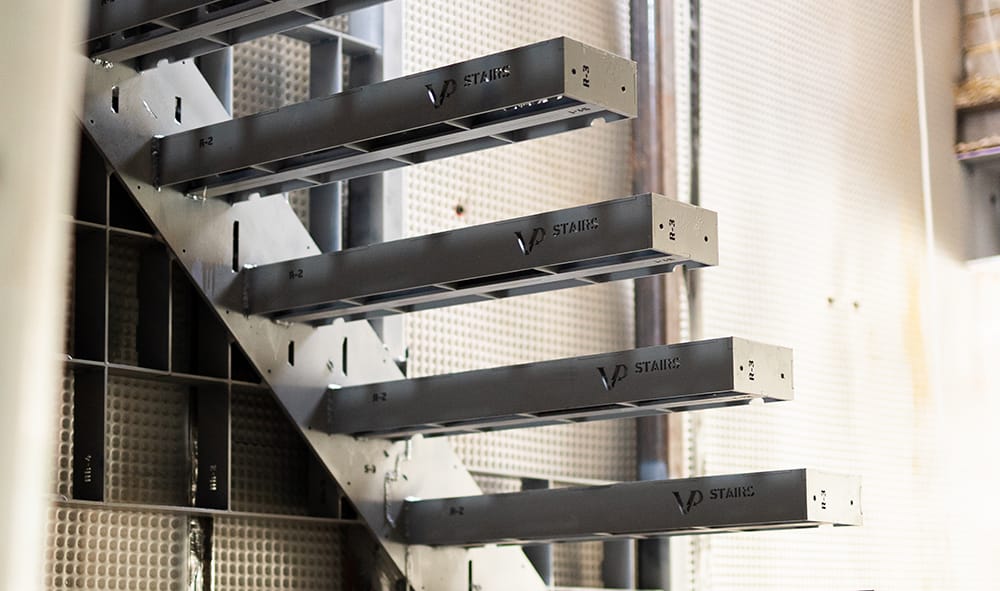
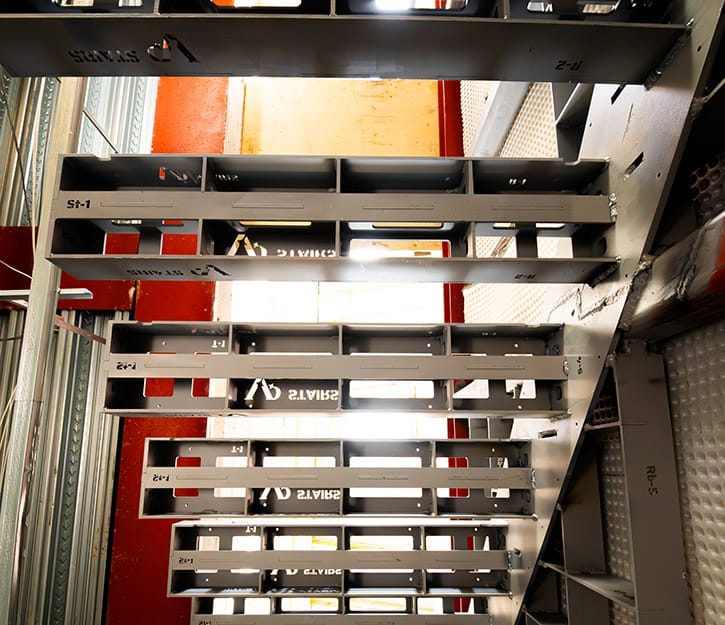
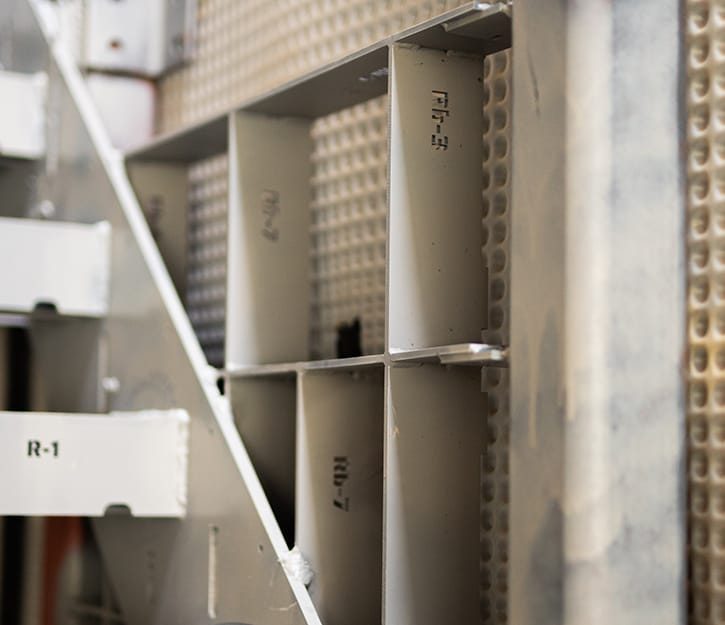
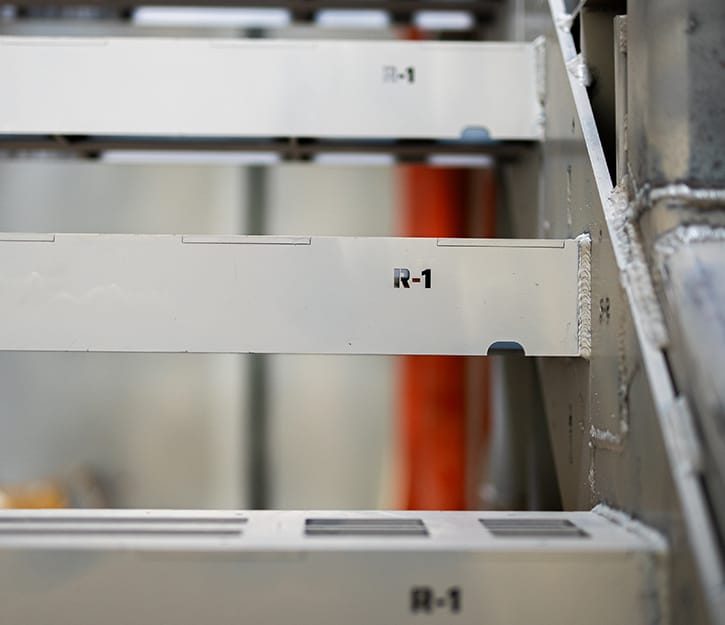
Here is where The Cantilever departs from the usual playbook. Instead of bolting elements together, we joined the stringer and treads using a tab and slot joint, then welded it. This is an old joinery principle. A projecting tongue, the tenon, seats inside a matching slot, the mortise and here the tenon of one steel element sits inside the slotted mortise of the other before the weld is run, so the joint is mechanically located and fused. At V.PSTAIRS, we were the first in the UK to successfully apply this technology to a metal staircase frame.
Why does is important? A bolted metal frame can loosen over time, and once there’s play in the joints you get vibration, creaking and drift. A tab and slot joint doesn’t carry that risk: the connection can’t loosen, deform or work free, because it isn’t relying on clamping force.
It’s the difference between a frame held together and a frame that has become a single rigid object. We achieved this stiffness without adding weight, which on an unanchored basement frame. If you’re curious how complexity like this feeds into cost, we break the variables down in our guide to metal frame staircase costs in the UK.
Load, Longevity and a Frame to Trust
The numbers tell the rest of the story! This frame holds a static position under 700 kg with no measurable wobble, vibration or displacement, and that’s before you add the dead load of the stone cladding and the glass balustrade it was built to carry. For a staircase with no wall to lean on, that’s the figure that lets everyone sleep at night.
Durability was engineered to the same standard. Our preliminary calculation sets the steel grade and thickness to deliver corrosion stability, which is why we back the metal frame with a guarantee of no less than 25 years. The work was carried out in line with UK building regulations and our internal standards throughout, with dimensions re-checked on site rather than trusted blindly to the model, because a frame destined for stone has no margin for guesswork.
At V.PSTAIRS we design, manufacture and install bespoke metal staircases across London and the rest of the UK, including the difficult cases other people walk away from. If you’ve inherited a project that isn’t working, or you’re planning a metal frame staircase that has to perform as well as it looks, the right starting point is a conversation. The first consultation is free, so get in touch by phone, email or through the form on the site, and we’ll take it from there.