How to Choose Between Helical and Floating Staircase?
Staircases are something that mankind has used for hundreds of years and continues to use today. However, the evolution of staircases has taken a giant leap forward in recent years. Homeowners now have a wide choice of materials, finishes, and designs. In our experience at V.PSTAIRS, many people in the UK are now considering helical and floating designs. Moreover, some of them find it very difficult to make a final choice between the two designs.

Each of them is an excellent solution that can perfectly complement any room with any interior style. However, what should you choose in the end? The answer to this question requires a detailed study of the two options, consideration of real cases, and the creation of a checklist. If you still can’t decide between a helical and a floating staircase, read this article to the end! 

Briefly About Helical Staircase

modern helical staircase

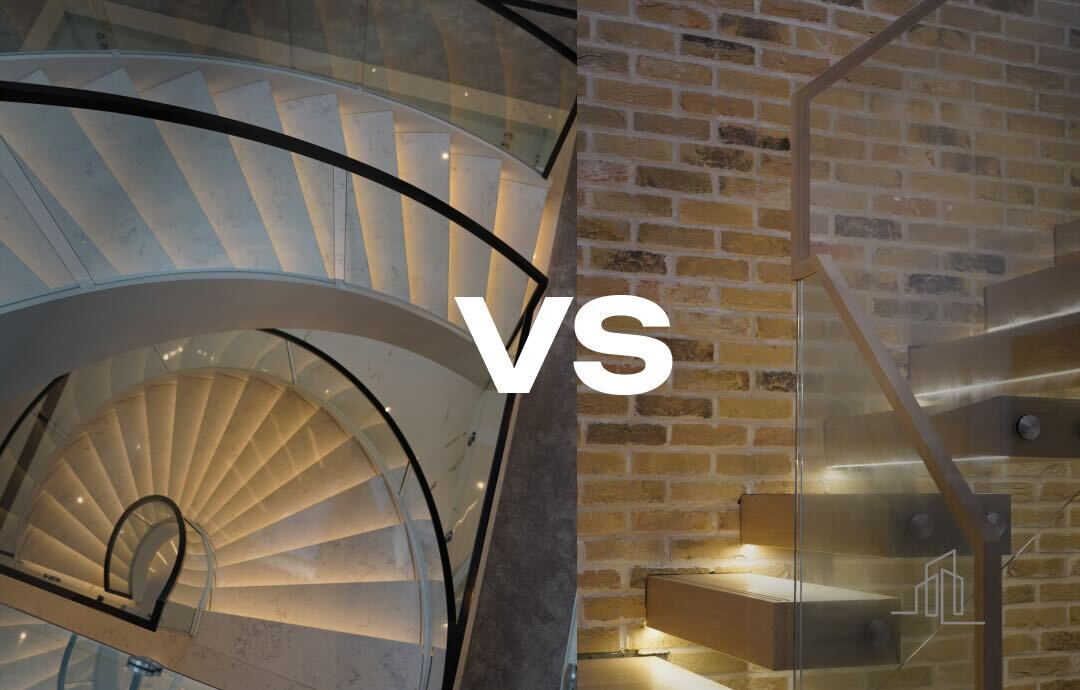
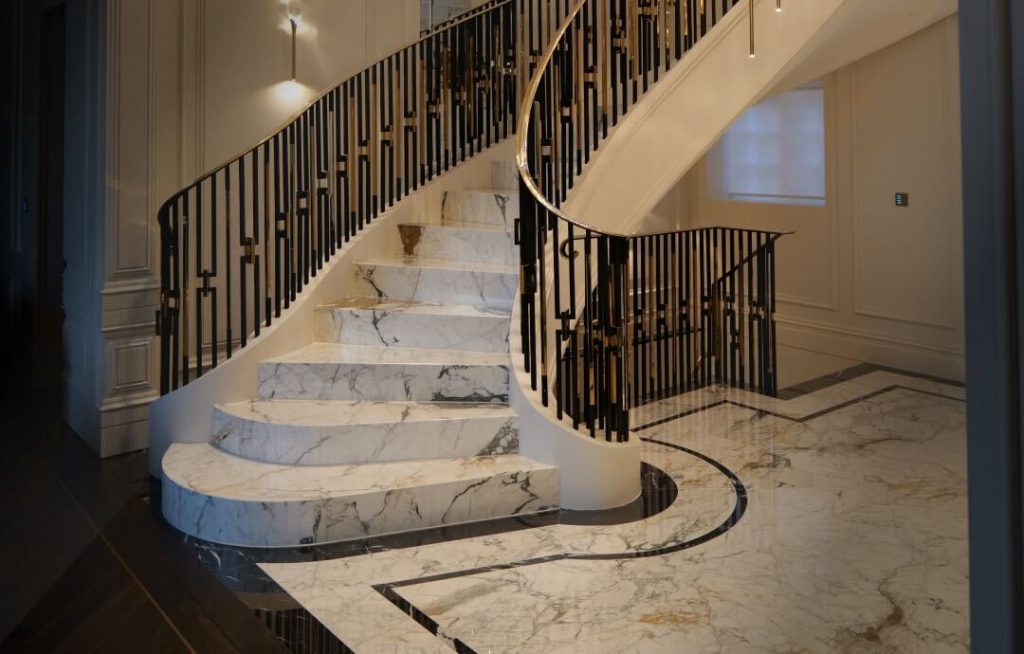
A helical staircase follows a smooth, sweeping curve, usually forming part of a helix rather than wrapping tightly around a central pole. Unlike a simple spiral, it typically has two stringers (inner and outer) with treads radiating between them. This creates a wide, flowing line that can connect floors in a very natural way.

Helical stairs are often used as a visual focal point, sitting in the middle of a hallway or open-plan space rather than being pushed against a wall. Their geometry demands careful engineering and precise fabrication, but the result is a continuous, sculptural form.

Main Pros of Helical Constructions

  • Strong visual centrepiece that immediately adds a high-end architectural feel.
  • Smooth, flowing geometry creates a comfortable, natural walking line between floors.
  • Works well in open spaces, allowing views through and around the stair.
  • Highly customisable in materials and detailing to match contemporary or classic interiors.

List of Potential Cons

  • Typically requires more floor area than straight designs.
  • Complex engineering and fabrication often make it a premium-priced option.
  • Installation can be challenging in existing homes with limited access.
  • Design errors are costly to correct due to bespoke curved components.

Briefly About Floating Staircase

modern floating staircase

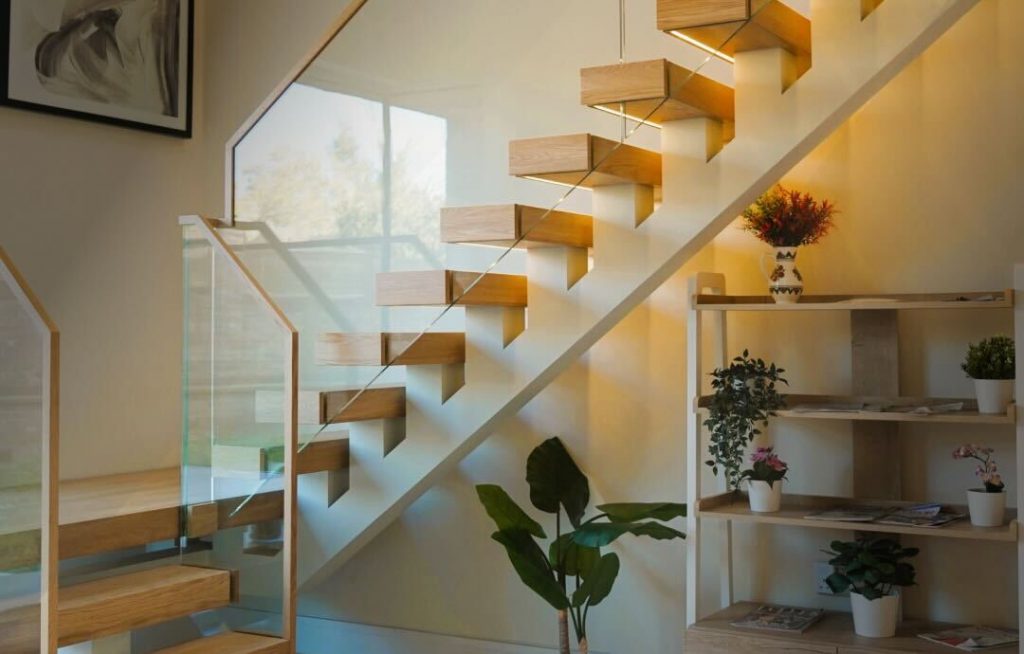
A floating staircase is designed so that the supporting structure is hidden or visually minimised, giving the impression that the treads are suspended in mid-air. This effect is usually achieved with concealed steelwork within the wall or slim stringers that are set back from the edge of the steps. The result is a clean, open line with no bulky supports.

Floating stairs are typically used where homeowners want to keep sightlines open and maximise natural light. Because the construction is largely concealed, coordination between structural design, wall build-up and finishes is crucial from the very start of the project.

Floating Staircase Benefits

  • Visually light design that keeps rooms feeling open and uncluttered.
  • Allows more natural light to pass through the stair area.
  • Ideal for modern, minimalist and open-plan interiors.
  • Space beneath the stair can be used for storage, seating or a desk.

Some of the Drawbacks

  • Requires strong supporting structure and careful engineering from the outset.
  • Some users may feel less secure due to the “open” appearance.
  • Poor detailing can lead to noticeable movement, squeaks or vibration.
  • Strict attention to building regulations and safe balustrades is essential.

Design and Space: Which Works Better in Your Home?

As we mentioned above, both helical and floating staircases are modern solutions for any home. See for yourself by exploring the V.PSTAIRS portfolio, which features our latest projects. So, let’s take a closer look at how both of these staircase designs work in different spaces.

Design and space should be your starting point when choosing between helical and floating staircases. A helical stair usually needs more room to breathe: it looks best when it can sit slightly away from walls, with enough clearance around the curve to appreciate its shape. This makes it well suited to generous entrance halls, double-height spaces and open-plan layouts where the stair is intended to be the main feature. If your home has a strong architectural axis (for example, a front door aligned with a view) a helical form can emphasise that line and create a sense of arrival.

Floating staircases are more flexible when floor area is limited or when you want the staircase to feel almost invisible. With open risers and minimal structure, they work well along a wall, in narrow corridors or in compact living spaces where every square metre counts. They are particularly effective where you want light to travel freely between floors, or where glazing, feature walls and artwork should remain in view. In many UK homes, a floating design can modernise an existing layout without demanding a complete redesign of the ground floor.

Simple Checklist for Making Your Final Decision

  • Do you have a generous entrance hall or double-height space? → A helical staircase will make the most of it as a central feature.
  • Do you want to keep the interior as light and open as possible? → A floating staircase will help maximise natural light and clear views.
  • Is your home a compact house or townhouse with limited floor area? → A well-planned floating design usually works more efficiently.
  • Do you need a real “wow” moment as you enter the home? → A helical stair acts like a sculptural statement in the centre of the space.
  • Are you aiming for soft, flowing lines rather than sharp minimalism? → A helical staircase will better support that design language.

Any Staircase Solution in V.PSTAIRS

We hope our article will help you make a final decision that you will enjoy. Regardless of the type and shape of the staircase, you should contact the leading staircase builders in the UK. For example, at V.PSTAIRS, we help in London and other cities with the construction and installation of staircases from scratch. This saves you the hassle of finding and hiring multiple contractors. You get a one-stop solution.

Our team will analyse your request, suggest the best solution, and provide an accurate cost estimate and project completion date in advance. This way, we provide comprehensive staircase design and installation services, regardless of the type and shape. Any materials, any finish and the realisation of any of your ideas! Where to start? Contact us in any convenient way to get a free consultation as soon as possible!